Being in Austin

stock photo

Tuesday in Austin, where I spent most of a week attending the (SXSW) South By Southwest Film Festival on behalf of Winter’s Bone. The film was very well received at SXSW. It was not in competition, but was listed as a “Favorite.” Audiences seemed to agree, as it played to a packed house at both screenings, with more than a few turned away. One of its fans, I discovered, was Elle Magazine film critic Karen Durbin, with whom I shared breakfast on Tuesday at the annual Chicken and Egg Films gathering for women narrative filmmakers. The chosen forum was Sandra Bullock’s very upscale but also very comfy Bess Bistro, which the cab driver couldn’t find and dropped me off three blocks away in the rain. I was self-concious going in, because the invite was for Winter’s Bone  Director Debra Granik, for whom I was subbing. But everyone seemed happy that Winter’s Bone was represented, and I was joined there by Roadside Attractions exec Dustin Smith, who was also at the festival promoting the film. I ran into Karen later that evening at the awards, where she presented the top narrative feature award, and we wandered down to the wrap party at Maggie Mae’s along with Variety film critic Peter Bart. The scene was too crowded, too noisy and too unrelentingly young for Karen and I, so we left Peter to his own devices and instead spent a quiet, balmy hour on a bus stop bench talking films, music and life in general. Too late to catch Metro #17 back to Irene and Bob’s, I flagged a taxi instead and called it a good night.

Posted in Winter's Bone | Tagged , , , , | 1 Comment

Marideth quoted in Slant magazine

photo credit; S. Denton, Moonmooring

…”I had trouble thinking people could come in from New York and make an authentic movie about the Ozarks, but I have to say they did it,” said Marideth Sisco in the Q&A after Winter’s Bone. Sisco, who lives near the hardscrabble Missouri country where the movie was filmed…

Read the rest of the article at Slant magazine. Scroll down about five paragraphs to see the whole article.

Winter’s Bone

Posted in Winter's Bone | Leave a comment

In Austin Texas

photo credit; S. Denton, Moonmooring

Marideth is in Austin Texas at the South-By-Southwest Music and Film Festival for the showing of Winter’s Bone. We should hear more from her in a couple days!

Meet the film maker Debra Granik.

Posted in Winter's Bone | Leave a comment

Excerpts from Costa Rica Journals: Talamanca: Chapter 17

I am awakened long before dawn by a sound that is pure hoodoo, a low throaty chant that rises to a peak and then falls away, only to begin again seconds later. Fortunately I have been briefed about the howler monkeys who lurk in the surrounding jungle searching for tasty fruits, and with their chorus of calls warn away threats, real and potential, to their colony. They have a particular distaste for early arriving delivery trucks, Miraflores Lodge owner Pamela Carpenter has told me.

It is day 26 of my stay in Central America. Four days from now I will be on _my way home to the United States. But for now I am in Costa Rica’s Talamanca province on the southeast Caribbean coast, near Panama. I have settled into my lodgings in Playa Chiquita. Built, as I discover, in traditional Bribri Indian fashion, the floors are made of well-sanded tropical hardwoods, as is the framing.

My room is upstairs under a high, vaulted roof of palm thatch and bamboo. Some walls are of wood, others are single-wall bamboo. None of the walls go all the way to the roof. Where there should be windows there are simple frames across which thin muslin curtains flutter in the warm breeze.

The bed is queen-size, comfortable and draped in mosquito netting. This is the part of Costa Rica where all the guidebooks caution you should not come without being immunized against a variety of dread diseases, such as malaria and dengue fever. I elected to avoid that advice because of these two, the most likely diseases to encounter, the medicine against malaria is reputed to make some as ill as the disease would, and for dengue fever, there is no vaccine. I am grateful for the netting over the bed, but in the sitting room, there are no screens, and few walls.
I go downstairs and ask about the effectiveness of my mosquito repellent. “For the three or four mosquitoes you may encounter around dusk, long pants work best, or a little citronella,” says Pamela, the woman who brought me here yesterday. “This close to the beach, the wind keeps them from building up. The jungle is the only place where you’ll need the repellent.”

She’s right. During the four days I stay here, I see two mosquitoes and am bitten once. The netting, she tells me, is to keep the small lizards who live in the rafters from falling on me as I sleep. They’re notoriously clumsy and often lose their footing, she says. They also have beautiful birdlike voices, and trill to each other in the night, sometimes making a delightful counterpoint to the rude and early-rising howler monkeys, who fire up their gutteral chorus around _4 a.m. every day, trucks or no trucks.

Posted in Costa Rica | 3 Comments

Excerpts from Costa Rica Journals: Monteverde: Chapter 13

I awaken to a “chilly” 55-degree sun-filled Monday in Monteverde, northwest of the capital city of Costa Rica on a mountainside overlooking Nicoya Bay from an altitude of 4,500 feet. It is my 21st day in Central America, with just 11 days left until my departure. And there is still much to do.

I am here to visit a community of people to whom sustaining their natural resources has meant survival itself. I look around my room at this lodge, the first structure built to house non-resident visitors to Monteverde. Minus one small wardrobe, the furniture is handmade, the bed rough-planed lumber bolted to a frame of peeled and dressed limbs, the mattress resting not on springs but on wooden planks.

When I said in the last series segment that the road to Monteverde is as much  metaphor as fact, this is part of what I meant. Where we tend to think of both American pioneers of the 19th century and Latin American campesinos of the 20th as people who move into an area, clear the land, grow a season or two of crops and move on, when the first Quaker families climbed the mountain and settled Monteverde, they knew they had literally come to the end of their road. They had purchased the only farmable, affordable piece of land large enough for them to live together. In a Quaker community, the community is paramount. From the start, they knew their choices had to forego preference in favor of what would sustain them. They had spent all they had to come to this place. There would be no moving on.

Posted in Costa Rica | 2 Comments

Excerpts from Costa Rica Journals: Panama City: Chapter 7

Like a picture through a lens out of focus, it is difficult, even while sitting here, to capture the workings of an institution the caliber of the Smithsonian Tropical Research Institute (STRI) against the backdrop of this teeming and sometimes seedy Central American metropolis. Harder still is the further view, both within the metropolis and the rural area that surrounds it, of the grinding poverty that salts this land from border to border and sea to sea. Panama’s economy is, and has been for decades, based on the services industry, which accounts for three-fourths of its Gross Domestic Products(GDP). With a 13 percent unemployment rate and 37 percent of its people living below the poverty line, it is in better shape than most of its neighbors, but it is still not a wealthy country. Its principal exports are bananas, shrimp, sugar, coffee and clothing. Its biggest customer is the United States, which purchases 42 percent of its products, and provides 39 percent of its imported goods. After a long period of political unrest, the government is now stable, but economic growth has still not recovered. Environmental laws are on the books, but still absent is the money to fund them. One national park is guarded by just one ranger, and that ranger does not have a vehicle.

Posted in Costa Rica | 2 Comments

Costa Rica

In 2002, The West Plains Daily Quill received a $5,000 grant from the U.S. chapter of the International Press Institute. A representative from the newsroom was charged with the assignment to go somewhere outside the U.S., preferably somewhere where they didn’t speak the language, and attempt to investigate and deliver a story on a subject chosen in the grant application. “We want a reporter to be dropped into a place where they are lost and mute, and discover the story as well as how people outside the U.S. view us.”

Publisher Frank Martin III gave me the assignment: to compare the treatment of natural resources in Central America (Costa Rica and Panama) with how they are treated in the Ozarks. That was the official assignment. But when the news got around about what I was about to do, virtually everyone responded with the same words, or variants thereof: “I wish I could go with you.”

I decided to see if I could do that. First, I acquired  a donated GPS unit. Then I made an agreement with Sharon Lewis Orlikowski wherein I would e-mail her Willow Springs social studies class regularly with details on my whereabouts, and answer e-mails if they had questions. A sample:

Harry: Have you seen any bromeliads?

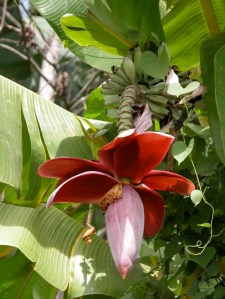
Bananas in bloom.

Me: Billions!

I spent six weeks there, using public transportation and leaning heavily on the kindness of the expat Quaker community, particularly Jo Reinmill, a librarian at the San Jose Country Day School, who lent me a room in her house, gave me a key and offered some essential survival info.

The result, a 20-part newspaper series with numerous photos that read like a travelogue, while answering the natural resource questions. It has morphed since then into a book that I’m calling The Costa Rica Journals. Excerpts  can be found here.

Bribri bus stop

Excerpts From Costa Rica Journals; Chapter 2
Excerpts From Costa Rica Journals; Chapter 7
Excerpts From Costa Rica Journals; Chapter 13
Excerpts From Costa Rica Journals; Chapter 17
Excerpts From Costa Rica Journals; Chapter 18

Posted in Costa Rica | 1 Comment